
New to private label? Download our free 20-page guide to launching your first product.
The three main pet supplement formats are soft chews, powders and liquids. Soft chews sell best because pets take them like treats, but they cost the most to make and develop. Powders are the cheapest way to launch and allow high doses. Liquids suit cats, small dogs and precise dosing. Choose based on your pet, your dose and your sales channel.
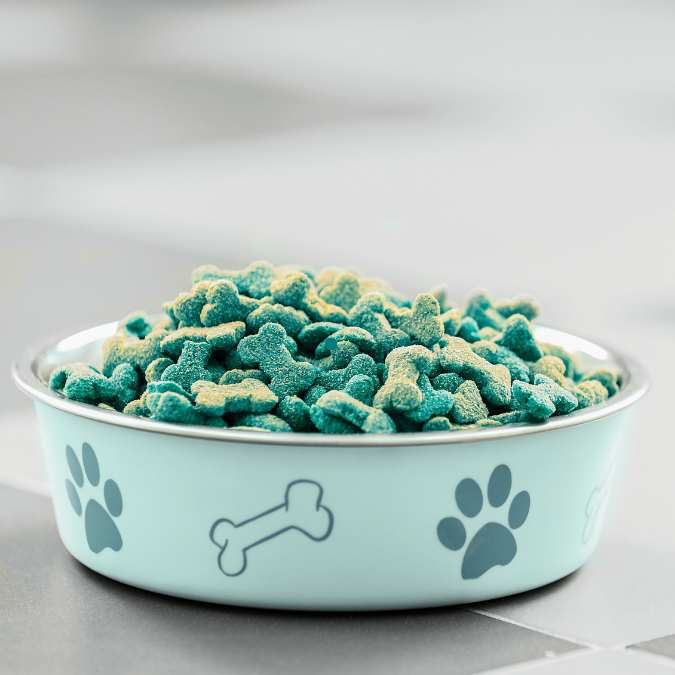
Most founders who start a pet supplement project with us already know the benefit they want to sell: calming, joints, skin and coat, or digestion. The format question comes second. Even so, it shapes almost everything after it, from unit cost to the rules for your label. This guide walks through the trade-offs the way we explain them on a first call.
How pet supplement formats compare at a glance
Here is the short version. We explain each row below.
| Format | Main strength | Main trade-off | Often a good fit for |
|---|---|---|---|
| Soft chews | Pets take them willingly, so owners stay consistent | Most complex to make; dose per chew is limited | Dogs, retail shelves, subscription brands |
| Powders | Lowest cost per serving, high doses, flexible by weight | Owners must mix them into food; picky eaters notice | First launches, joint and probiotic blends |
| Liquids | Precise dosing, easy for cats and small dogs | Preservation, packaging weight, taste masking | Cats, small breeds, oils and drops |
Welsdom makes all three for dogs and cats. Our pet program also covers chews, creams and functional treats, with minimums starting at 100 units.
Soft chews: the format pets ask for
Soft chews are the pet supplement format owners notice first in a store. A soft chew looks and smells like a treat, so the dog takes it without a fight. That matters more than most founders expect. A pet supplement only works for your brand if the owner keeps giving it, and that drives repeat orders.
What you can customize at Welsdom:
- Flavour: chicken, beef, bacon, peanut butter and salmon, the flavours pets in North America accept most readily.
- Size: standard, mini and large-breed chews, so the dose can scale with body weight.
- Shape and cut: individually cut or stamped chews for consistent dosing.
- Packaging: resealable stand-up pouches or screw-top jars, with bilingual English and French labels for Canada.
The trade-offs. Soft chews take more development than any other format. The chew base has to hold the actives, keep its texture and stay palatable for the whole shelf life. Some ingredients have a strong taste or smell that is hard to hide. A chew also has a physical limit: if your dose is large, you may need two or three chews per serving, which changes your pricing. Expect a higher unit cost than a powder of the same formula.
Soft chews tend to win in specialty pet retail and direct-to-consumer subscriptions, where premium positioning helps. Our private label pet soft chews page lists the common categories and grain-free options.
Powders: the lowest-risk way to launch
Powders are the workhorse of pet supplement formats. They allow high active loading per serving, so a joint formula with glucosamine, chondroitin and collagen can reach a meaningful dose in one scoop. Dosing by weight is easy: one scoop for a small dog, two for a large one.
What powders do well:
- Lower cost. Blending and filling powder is simpler than forming chews, so the unit cost is lower.
- Flexible packaging. Stand-up pouches, jars, single-serve stick packs, sachets and kraft paper pouches.
- Unflavoured options. An unflavoured powder can go undetected in food, which helps with picky eaters. Meat flavours such as chicken, beef or salmon can also mask strong-smelling actives like probiotics.
The trade-offs. Powders ask more of the owner. They have to remember to sprinkle it on each meal. Also, a dog may refuse food if the powder changes its smell. Some actives also pick up moisture once the owner opens the pouch, so packaging and storage directions matter. A probiotic powder needs a strain and a package that keep it stable for the shelf life on the label.
If you are testing a market with limited cash, a powder is often the safest first pet supplement. You can add a chew version later once you know the formula sells.
Liquids: precise dosing for cats and small dogs
Liquids include oils, drops and pumps. Fish or plant oils for skin and coat are the classic example. A dropper or pump lets the owner measure small doses precisely, which suits cats and toy breeds that will not take a chew.
The trade-offs. Liquids are the most demanding format to keep stable. Water-based liquids need a preservation plan, and some fresh liquid products need refrigeration. Oils can oxidize and go rancid, so they need antioxidants and light-protective bottles. Liquids are also heavier to ship, and bottles cost more than pouches. Taste masking is harder too, because the pet tastes the product directly.
Our liquid vs powder supplements guide covers the same trade-offs for human products, and most of them apply to pets as well.
Choosing between pet supplement formats: five questions
When a founder can’t decide, we work through these questions in order.
- Which species? Cats are pickier than dogs and more sensitive to certain ingredients. Many cat products end up as powders or liquids. Some ingredients that are fine for dogs are not safe for cats, so we screen every formula for its species.
- How big is the dose? If the daily dose is several grams, a powder may be the only practical format. A chew that needs three pieces per serving costs more and frustrates owners.
- Where will it sell? Pet retail and boutiques favour chews. Veterinary clinics are often comfortable with powders and liquids. Amazon and Shopify brands often lead with chews for the photos and reviews.
- What is the budget for a first run? Powders give you the most product for the money. Chews cost more per unit, so plan your launch price around that.
- What will the label say? The claims you plan to make affect the regulatory pathway, regardless of format. See the next section.
Pet supplement labelling and regulation by format
The format does not decide which rules apply. The claims and ingredients do. In Canada, a low-risk supplement in dosage form, such as a chew, powder or liquid sold to maintain or promote an animal’s health, is usually a veterinary health product (VHP). Health Canada requires companies to notify it at least 30 days before selling a VHP, and every active ingredient must appear on its List C of permitted substances. The label must carry the statement “Veterinary health product / Produit de santé animale.” Details are on Health Canada’s veterinary health products page.
VHPs are not for treating, preventing or curing disease. A claim like “treats arthritis” moves a product into the veterinary drug pathway, which is a much longer process. “Supports healthy joints” is the kind of wording that stays within a VHP.
A functional treat sold mainly as food is a different case. The Canadian Food Inspection Agency notes that pet food is not comprehensively regulated in Canada and that its oversight focuses on import and export (CFIA overview). Retail labelling still has to meet consumer packaging rules. For the US, the FDA regulates animal food and drugs, and many states follow AAFCO model rules for pet food labels. We review the label and claims direction with you before production.
What a first pet supplement production run looks like
Once you pick a format, the process is the same for every product:
- Choose the pet need: species, benefit, format, flavour, quantity and sales channel.
- Develop the launch version: formula, packaging, label requirements, claims direction and timeline, with sampling and refinement.
- Manufacture and ship: production in our Newmarket, Ontario facility, then delivery to your warehouse, Amazon, a 3PL, a clinic or a retailer.
Typical timelines run 4 to 8 weeks from approved sample to finished inventory, depending on the formula, packaging and order size. Soft chews usually need more sampling rounds than powders, because texture and taste both have to pass.
Frequently Asked Questions
What is the most popular pet supplement format?
Soft chews are the most popular consumer format for dogs. Pets take them like treats, which helps owners give them every day. Powders and liquids are still common for cats, small breeds and high-dose formulas.
Which pet supplement format is cheapest to launch?
Powders are usually the cheapest. They are simpler to blend and fill than chews, they allow high doses per scoop, and they pack into low-cost pouches. Many brands launch with a powder and add a chew later.
Can I offer the same formula in more than one format?
Often, yes. For example, we can make a joint or probiotic formula as both a powder and a soft chew. The dose per serving and the flavour system usually need adjusting, and each version needs its own label.
What is the minimum order for a private label pet supplement?
Welsdom’s pet program starts at 100 units. Your quote confirms the minimum for your format, formula and packaging, since chew size, flavour and pouch printing all affect run size.
Do soft chews, powders and liquids need different approvals in Canada?
No. The format doesn’t change the pathway. What matters is your ingredients and claims. Most brands notify Health Canada of a pet wellness supplement as a veterinary health product, whatever the format.
If you’re ready to compare formats with real numbers, request a quote through our pet supplement OEM manufacturing page.